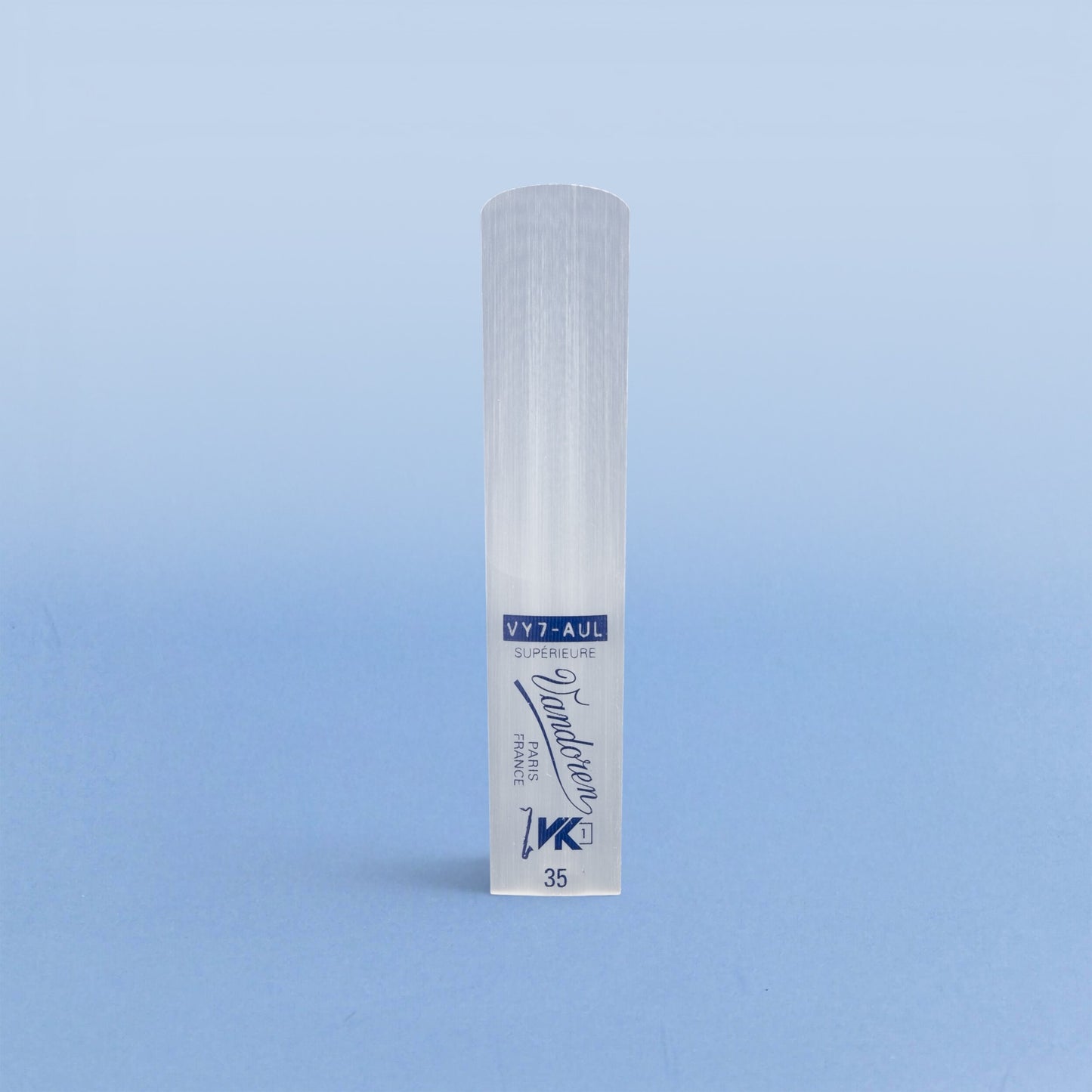
Vandoren VK1 Synthetic Bass Clarinet Reed
Vandoren VK1 Synthetic Bass Clarinet Reed
It finally happened. When the VK1 came out for Bb clarinet, the first question every bass clarinetist asked me was "when's the bass version?" — and for a couple of years the answer was "no bass clarinet just yet." Well, here it is.
If you're new to the VK1: Vandoren spent seven years developing a composite material that doesn't try to imitate cane's structure — it reproduces cane's acoustic behavior. The result is the first synthetic reed that sounds great without the disclaimer "...for a plastic reed." No soaking, no break-in, and impervious to the humidity swings that turn cane reeds into Ruffles potato chips. Oh, and it's washable, if that's your bag.
For many bass clarinetists, the synthetic case is even stronger than it is for soprano players. Many bass clarinets sit in a pit for 45 minutes only to be picked up and played for 5 measures. Cane = ruffles potato chip warped. Synthetic = ready-to-play.
Now, the strength system, which I think is dumb. The VK1 uses its own numbering (35 through 55 for bass), which maps roughly to cane like this: subtract 10, divide by 10. To make things simpler, here's my reference chart:
If you play a Vandoren Traditional reed, here's my advice:
- If you like a soft 3, try the VK1 35
- If you like a 3, try the VK1 40
- If you like a hard 3, try the VK1 45
- If you like a 3.5, try the VK1 50
Three more things. First, synthetic doesn't mean identical: two VK1s of the same strength will feel different. Second, synthetic reeds are really sensitive to placement on the mouthpiece. A half-millimeter offset and it is total crap. So find your place and stick to it.) Third, synthetics get "tired" after a couple of hours of continuous playing, so buy two or three and rotate.
Finally, these reeds are not returnable because the factory seal has to be broken to try one. (Sorry!)
Légère or VK?
Until now, my standing recommendation for synthetic bass clarinet reeds was Légère — specifically the Tenor Sax French Cut (yes, tenor sax reeds work on bass clarinet; they're nearly identical). So how does the VK1 stack up?
First off, it's good to know that they're made completely differently. Légère cuts polypropylene blanks on a CNC machine, the way you'd cut cane. Vandoren molds the VK1 from a fiber-reinforced composite, with the goal of behaving acoustically like cane.
Here's what I found playing them side by side. The Légère articulates better and responds quicker, and of the two, it feels and sounds more like cane to me. The VK1 holds its core better and has a better overall tone — noticeably less buzzy. I suspect it's got a thicker heart. (For the record, I personally feel cane is still superior to both. I treat synthetics like "in case of emergency, break glass" moments.)
Both run hard relative to their numbers. With Légère, knock off a quarter to a half strength from your cane number. With the VK1, use my formula — subtract 10, divide by 10 — then go a notch softer.
One more practical difference: Légère offers a 30-day exchange if you get the strength wrong. The VK1 has to be unsealed to play it, so it's not returnable. Your first VK1 strength choice carries higher stakes, which is why my conversion guidance above errs soft.
My verdict? For my own playing, the Légère, because articulation and response are what I'm looking for. But this one's closer than I expected, and if the "buzz" of a Légère is what's kept you off synthetics, the VK1 might be your answer.
Couldn't load pickup availability