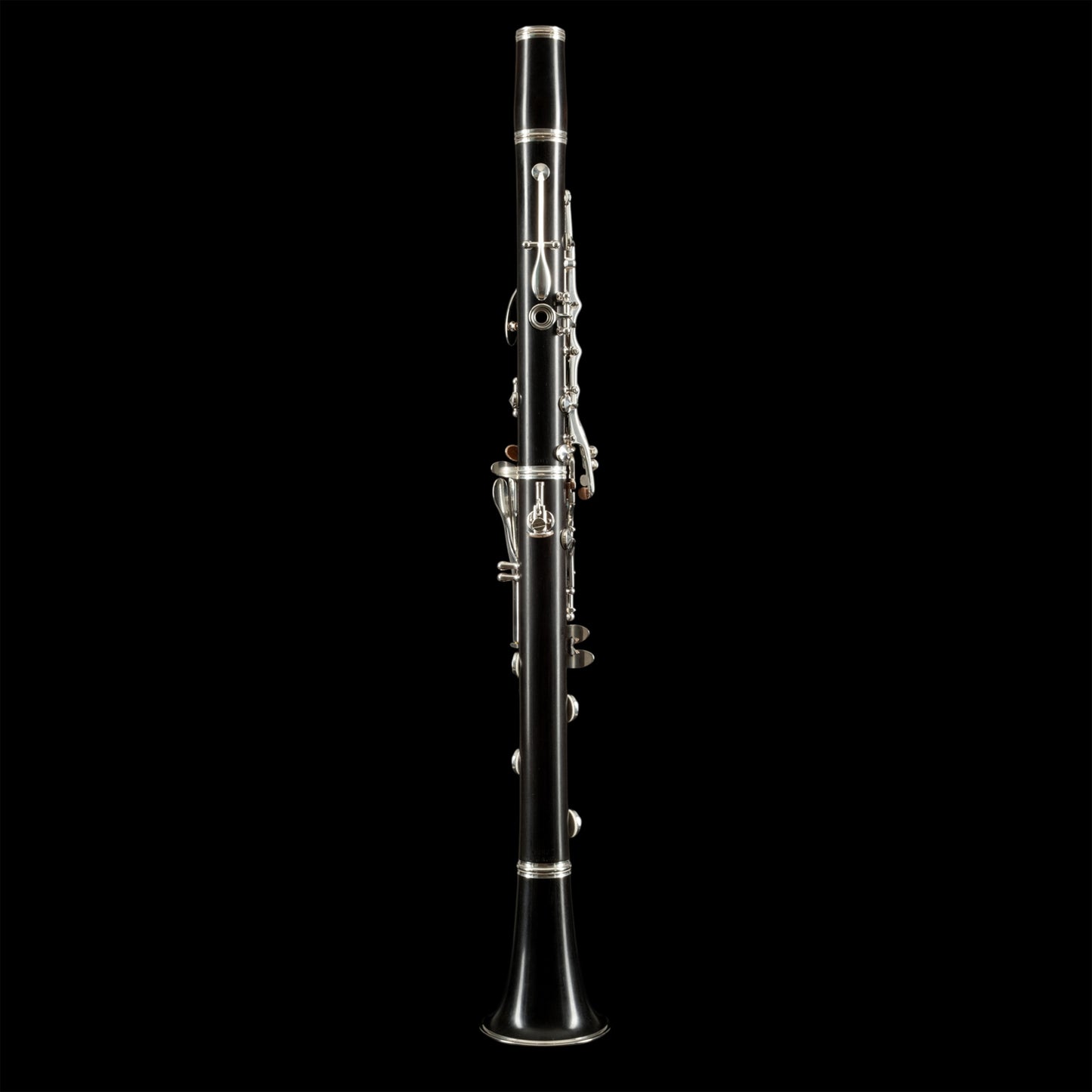
Yamaha CSVR Bb Clarinet
Yamaha CSVR Bb Clarinet
Honesty time.
I'll be upfront: I wasn't carrying Yamaha for a long time, partly out of stubbornness and partly because the instruments I already carry are hard to beat, but once I tried the CSVR at ClarinetFest I knew that had to change. They also happen to be the most free-blowing clarinets I carry — which I did not see coming. More on that in a sec.
First a little more background: Yamaha didn't want to open me up as a dealer because I won't carry their Bass Clarinets — I really don't like them — and after I kept saying "Bass clarinet? No thanks," they just said "No thanks." And then they stopped returning my emails.
Soooooo, third upfront thing: I now source them directly from an authorized Yamaha distributor overseas, which means two things — 1) I get them straight from the source, and 2) I provide the warranty directly, which makes things quicker. This also has a third benefit to you in that I can offer them at a very competitive price, though that's just a side benefit.
Okay enough backstory.
I know Yamaha makes student clarinets that people (read: band directors) seem to like, but Yamaha Professional Clarinets?
I shouldn't have been surprised, but I was — Yamaha's Custom line...man, it's almost unfair how consistent they are. Play five R13s and you'll find five different instruments; play five CSVRs and you'll find...five CSVRs, because Yamaha's manufacturing precision is legendary.
SEVR or CSVR?
The CSVR has a more cylindrical bore than the SEVR, with smaller tone holes and a tighter undercut, which in theory (and in practice) gives you a focused, bright, clear sound — think "R13 character," but more even and predictable than an actual R13 tends to be.
One thing I wasn't expecting: this instrument is super free-blowing, and given the smaller tone holes, I assumed I'd feel more resistance — nope. It's among the lightest-blowing instruments I carry, which means a wide tonal palette is available to you, but controlling that palette means you are going to have to manage pitch more actively.
How it plays
It speaks faster than anything else I've analyzed. And the top three registers all respond at the same rate — throat, clarion, altissimo — instantly. Only the very bottom of the chalumeau takes longer, which is true of every clarinet ever built. If you've spent years fighting an instrument to get notes to start cleanly, this is going to feel like cheating.
Here's the part I didn't expect from something this light-blowing: it holds pitch well when you push it. Most free-blowing clarinets fall off a cliff in pitch when you push on the bottom register, but this one is one of the steadier instruments in my catalog from soft to loud. The low register still drops when you really go after it, but the top of the instrument barely budges.
It also sat right at pitch when I recorded it, which is worth knowing if you've been reading these pages in alphabetical order and wondering why every other clarinet needs attention somewhere or other. This one doesn't.
The tuning "issues" (if you can call it that) are in two specific places: the throat tones sit low (typical) and the notes right above the break sit high (also typical). That's where the free-blowing thing catches up with you — an open instrument gives you all the room in the world, including room to be out of tune. I record everything on a Vandoren BD6, which is a very open mouthpiece, so what you see on the dashboard is close to a worst case scenario. A more closed mouthpiece or a more resistant aftermarket barrel takes most of it off the table. Twelfths, for what it's worth, are among the best-behaved in my catalog.
Finally, overall brightness lands in the middle of our catalog, which surprised me given how the thing is built.
Resistance: 3/10, Light
Both Yamahas sit at the light end of what I carry, so if you're coming from a more resistant clarinet, budget some adjustment time.
When listening for how a clarinet responds to added air pressure and embouchure control, listen to the Weber example (wide dynamic range and color range), then the Berlioz excerpt (wide dynamic range, but narrow color range), and finally the Gershwin excerpt (narrow dynamic range and narrow color range). You will hear how these clarinets respond — for better or worse! — to my input as a clarinet player.
Before you decide
The Buffet R13 is the obvious cross-shop, and it's the brighter instrument of the two, with a scale that moves around more and a lot more pitch drop when you play loud. What it has is the sound that's already in your head when you picture a clarinet. The CSVR gives you the same focus and clarity with less of the work.
The Uebel Rêve Grenadilla is brighter than this and slower to speak, with twelfths just as good. The Backun Q Grenadilla has the most accurate scale of anything in this bracket by a comfortable margin, plus the brightest top register of the group, though it's slower on the attack than either Yamaha (CSVR or SEVR).
Play or listen to all of them against each other in the audio player and pull up the dashboards side by side. If you're in New York, come play them in the shop instead — that's the better version of this.
Important note about this clarinet's warranty.
As I mentioned above, these are new clarinets that come directly from the source, which is why our price is so competitive (and the instruments are, shall we say...fresher).
The tradeoff: they don't come with the Yamaha USA warranty, because Earspasm isn't an official Yamaha dealer. So I provide one myself — five years, covering manufacturing and material defects, same exclusions as the factory warranty. If your instrument cracks or breaks on a covered claim, I'm your quarterback: I pay to fix it or replace it, and I handle the whole process. Just let me know you need help and I'll take it from there. (This assumes you didn't play hockey with it, of course.) Full warranty info is in the FAQ below.
View & compare detailed tuning, articulation and timbre data for every clarinet we carry.
-
65mm barrel
-
Pochette style case with fabric case cover
-
Adjustable thumb rest
-
Swab
-
Yamaha 4CM mouthpiece & ligature included
FAQ
Short answer: All earspasm instruments come with a 7-day trial. Please read my trial policy before pulling out that credit card.
Medium answer: You have 7 days from the date of receipt to try the clarinet. If you don't like it, that's fine (my feelings aren't hurt!) — just let me know and I will send you a return label. Box it all up and send it back. We keep 5% to cover credit card transaction fees and a (hopefully!) brief round trip back to Miles or John — my technicians — to do a reset on the horn.
Long answer: Read my trial policy :)
Yep, here's our shop warranty for Yamaha:
EARSPASM MUSIC — LIMITED WARRANTY YCL-SEVR Bb Clarinet
Earspasm Music warrants this instrument against defects in materials and workmanship for five years from the date of original purchase. This warranty applies to the original purchaser only and is not transferable. This matches Yamaha USA warranty terms
What we cover: If something goes wrong due to a manufacturing defect or workmanship failure under normal use, we'll fix it. All warranty service is handled directly through Earspasm Music — you deal with Michael, not a call center.
Wood cracks: Grenadilla is a natural material and most clarinet cracks are caused by environmental stress — dryness, temperature shock, inadequate warm-up — rather than manufacturing defects. We can't always tell the difference by looking, and we won't pretend otherwise. What we will do is make an honest, experienced assessment when you bring the instrument in, tell you what we think caused it, and tell you what we can do about it. If there's genuine doubt, we'll err toward you.
Cracks we determine to be manufacturing defects will be repaired under warranty. If the same joint cracks a second time following a prior warranty repair, we will replace that joint, including key transfer.
What we don't cover
- Damage from accidents, drops, misuse, or neglect
- Normal wear: pads, corks, key plating, springs
- Damage caused by repair or adjustment performed by anyone other than Earspasm's technician
- Instruments with altered, removed, or defaced serial numbers
- Any instrument purchased secondhand
How to use this warranty
Contact Michael directly at earspasm.com. You ship to us (your cost); if the repair qualifies under this warranty, we cover return shipping within the US.
Earspasm Music's liability is limited to repair or replacement of the affected component at our discretion. We are not responsible for incidental or consequential damages including lost performance opportunities.
Inspect the package before you sign off at delivery! If there are any issues resulting from shipping, we have taken out an insurance policy to cover damage (and loss). But we need you to document this damage or we can't do anything to help. Please read my trial policy for how to handle this issue, should it arise.
Not if you live in the Continental US! Because I want you to find the right instrument for you, and doing so online is harder than doing so in-person, I will cover the return shipping. Please read my trial policy for trial and return rules.
Yes. You can add your shipping address when checking out to see what the shipping costs will be before taking the plunge. Note that VAT and Customs Duties are not included in this cost.
Contact me to set up an appointment, and let's do it!
Couldn't load pickup availability