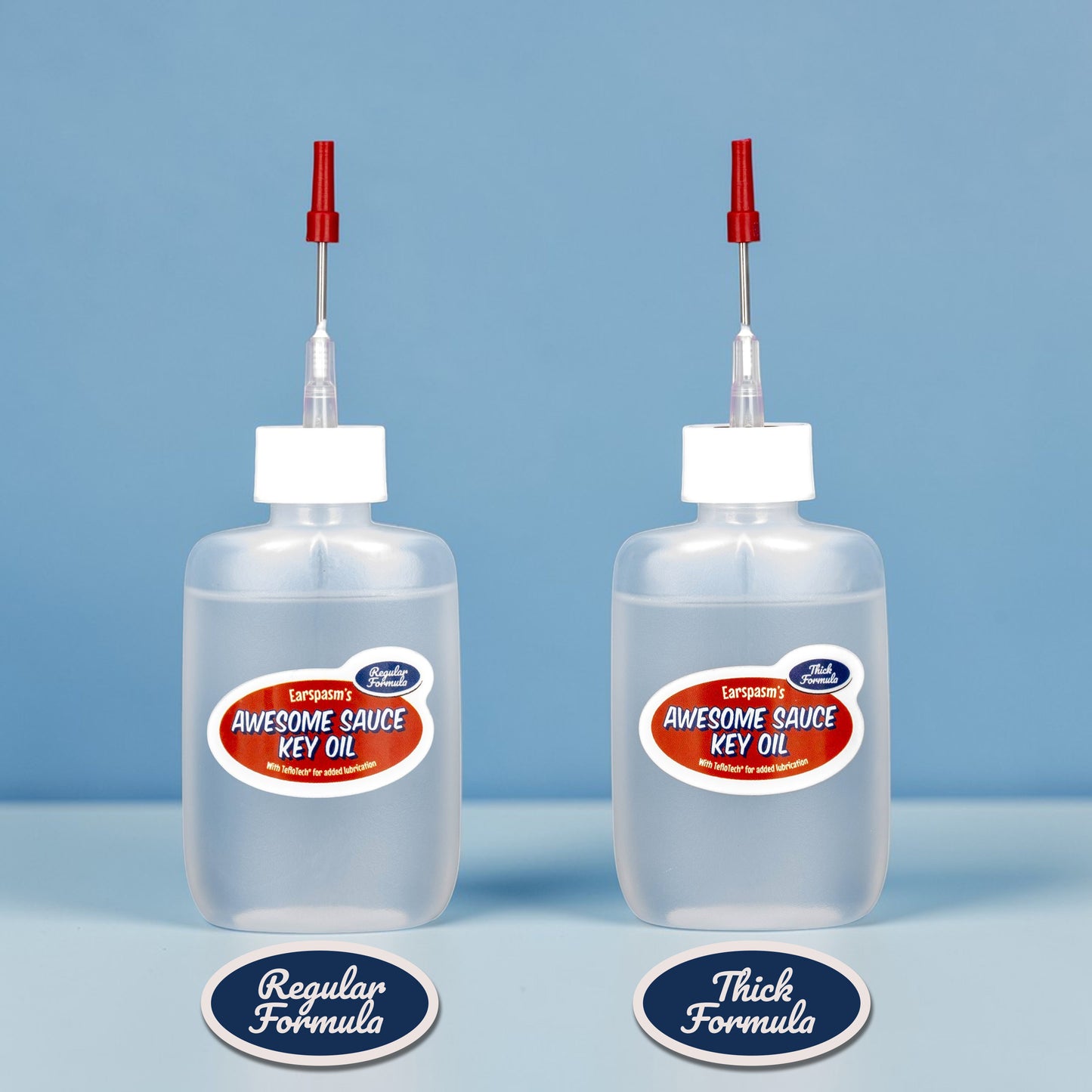
Earspasm Awesome Sauce Synthetic Key Oil
Earspasm Awesome Sauce Synthetic Key Oil
Your Key Oil Sucks
I never thought I'd get into key oil, but after doing some perfunctory research, I noticed that MOST KEY OIL IS CRAP.
Yep — it's either petroleum-based, or insanely over-priced for the quantity you get. So, once again, I went on a quest: find a key lubricant that is synthetic (no petroleum distillates), non-toxic/food-grade, has the right consistency (viscosity) for woodwind keys, and is non-gummy (so it doesn't attract and hold dust).
And I found it — at a food service machinery supplier. This is the stuff that's used to keep things like grocery store cheese-slicing machines lubricated.
What's TeflonTech®?
It's made-up. I invented it to get your attention. But it's not entirely unfounded; read on:
When I reached out to the food service place, they asked me if I was interested in including any additives; my initial thought was no, l don't need it to smell like Lavender, but I was curious and said, "sure?"
Their recommendation was something much more practical: they could mix in microscopic bits of teflon. After they explained what the Teflon did, it made SO MUCH SENSE: our rods and pivot screws are not perfectly smooth, and have little microscopic pits and scratches that cause friction. The teflon bits actually fill those imperfections so the lubricant can work against smooth surfaces. Holy crap, a revelation! "Yes," I said. "Gimme that."
Whaaa? Different thicknesses?
I then asked them to send different viscosities so I could test what worked best — I definitely didn't want something too runny, which has been my major complaint with key oil. And I discovered something: the clarinet and the bass clarinet need something different: Soprano Clarinets = tighter gaps between rods and posts. Bass Clarinet/all Saxes = wider gaps between rods and posts. The thinner lubricant worked fine on both clarinet, but a slightly thicker version worked AWESOMELY on saxes and low clarinets.
As a result, we're offering two different thicknesses: Regular (ISO 46) and Thick (ISO 68). The difference is minimal — we're talking the difference between canola oil (ISO 46) and soybean oil (ISO 68). Soybean oil clings to the pan slightly better.
How much do I get?
You get 1.25 ounces (37ml) in a needle-tipped oiling bottle. This is a LOT for under 10 bucks. For comparison's sake, MusicMedic's ULTIMAX key oil — which is probably the closest comparison — is $12 for less than HALF as much oil. Yes, I'm linking to a competitor. Yes you can conveniently buy theirs using this link. (Yes I think you'd be foolish to do so.)
I've never oiled my keys. How do I do it?
Ah, so you're one of THOSE people. No problem. First off, grab a key brush and clean the gunk out from between the keys and posts ("give your clarinet a thorough dusting," says Katherine). Then, place a drop of oil at all of the connecting points between rods and posts, and between rods and other rods.

If it's been a while since your clarinet had a COA (Clean/Oil/Adjust) and you're comfortable doing so, you can also disassemble a key from the clarinet and clean the pivot screws and rod screws, the key tube itself, the posts. Lubricate the screw or the post, and put it back together. You'll be amazed at how much better your keys will feel!


How long will this bottle last?
Conservatively, I'd say about 50 years. If I'm wrong, I'll be long gone before that timeframe is up, so you can yell into the void.
Couldn't load pickup availability