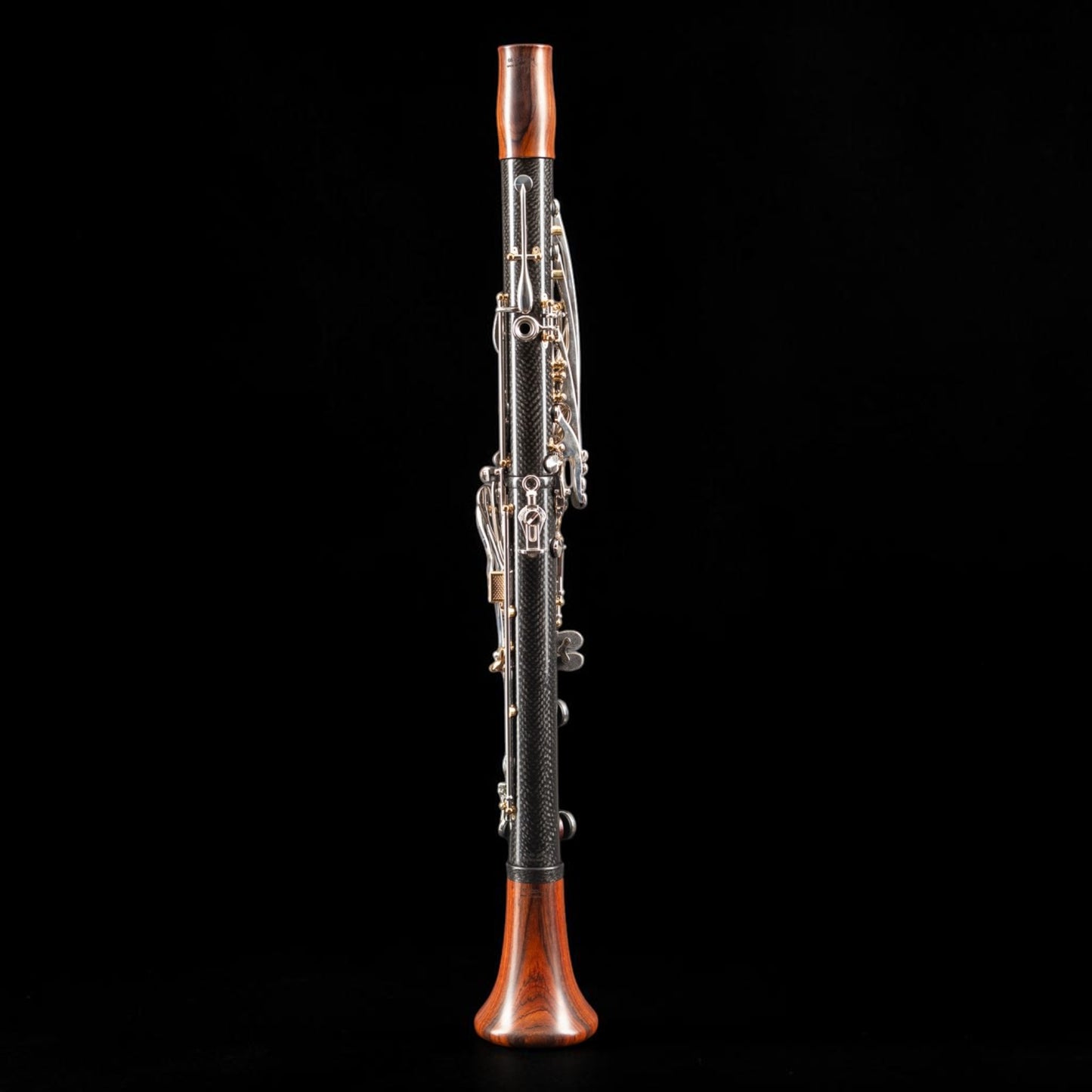
Backun CG Carbon Bb/A Clarinet
Backun CG Carbon Bb/A Clarinet
Backun showed the first CG Carbon in 2018. In the eight years since, they've made 180 of them. Total. I know because the Bb sitting in my shop is serial number 180, and it's the most recent one they've made. For comparison, Seggelke — a workshop where actual humans hand-build actual clarinets in actual Bamberg — has made thousands. As far as I can tell, this is the rarest clarinet in current production.
I ordered this pair — a Bb and an A — from Backun in March of 2023. They arrived a few weeks ago. Three and a half years. I'd half forgotten that I ordered them until I got the notice that they were ready. So if you've been wondering why you never see a CG in stock anywhere: now you know. And you're looking at two of them.
What is this thing?
It's Corrado Giuffredi's signature model. The body starts with a cocobolo core, which is machined down and wrapped in carbon fiber using a process Jeremy Backun and Joel Jaffe patented. Cocobolo is a gorgeous wood, but like all wood it moves with temperature and humidity. The carbon jacket is there to dramatically reduce that movement.
A lot of the acoustic design comes straight from the Lumière: same basic bore design, sculpted tone holes, Lumière barrels and Lumière bell. So there is plenty of familiar Backun DNA under all that carbon weave.
One thing nobody tells you about carbon fiber: it warms up sloooooowwwwwly. I'm finding fifteen or twenty minutes before the body is fully up to temperature, noticeably longer than an all-wood clarinet. But once it's warm, it seems to hold onto that warmth for a surprisingly long time. Warm up the A before you start some Mahler symphony and there's a decent chance it'll still feel warm when you finally need it. Kind of a useful quirk once you own one.
The core is cocobolo. My standing line is grenadilla projects, cocobolo warms — though if you've read my Lumière page, you know the data inverted on that particular pair, so hold the folklore loosely. Wood science lives in my wood primer if you'd like to go down that rabbit hole.
How does it play?
Let's go to the tape. This is the quickest-speaking clarinet I've played. It's like it sucks the note out of you.
What especially stood out is the altissimo. The attacks are incredibly quick, but the bigger surprise is how repeatable they are. Honesty time: my altissimo articulation is my Achilles heel. I have always struggled up there. On the CG, the attacks hit nearly identically take after take. That's something I noticed while playing it, and then saw again when I looked at the data.
The other story is evenness. Note to note, the color barely moves — nearly every note landed where my ear expected it. The sound gradually gets brighter as you climb until the altissimo, where there's a more obvious step in color. That's the main character change across the horn, and fortunately it happens up there where it is most common.
The throat tones are in tune. I'm going to type that again because of how rarely I get to: the throat tones are in tune. And the twelfths mostly behave.
How resistant is it?
Resistance: 6/10 — Medium
A comfortable resistance that evens out the timbre and response of the clarinet. Still, the response is the thing I notice most; notes start very quickly, particularly compared with some of the other clarinets in this price range.
Hear how it responds to volume in the audio player below — Weber first (wide dynamics, wide color), then the Berlioz (wide dynamics, narrow color), then the Gershwin (narrow on both).
CG or Lumière?
The cocobolo Lumière is the first clarinet I'd put next to the CG. They share quite a bit of acoustic design, and the Lumière costs considerably less.
My cocobolo Lumière has one of the most accurate scales I've measured, excellent twelfths, and beautifully matched color through the registers. It also pushes back more — I rate it 7/10 — and its attacks are slower than average. The CG gives me a quicker response and a slightly more open feeling at 6/10.
For me, the big reason to spend the extra money on the CG is that response, particularly in the upper register. If you're trying them side by side, bring something with repeated articulated altissimo notes (Sheherazade excerpts welcome).
And then there's the carbon-fiber construction itself. Some people will care a lot about having the wooden core stabilized this way. Others will play the two instruments and happily keep the several thousand dollars. That's why I have trials.
For my money (ha!), I think the CG is worth it.
Before you decide
At this altitude you should absolutely be looking across brands. Here are the ones I'd put beside the CG.
Seggelke Series 1000+. Seggelke clarinets are, in my view, the best in the world, and I say that right on their own page. The 1000+ sits at 5/10 resistance, has a strong core, and takes a lot of air without the sound spreading. The keywork also feels different from a Backun and takes some players a little while to get used to. If you're shopping at this level, I would absolutely play one. Jochen's approach to building a clarinet and Morrie's approach to the CG are about as different as you can get, which makes the comparison especially interesting.
Uebel Zenit. The Zenit is also around 5/10 resistance, responds quickly, and barely moves in pitch when you push the volume — one of the best results I've measured for that. It costs substantially less than the CG and gets you a startling amount of clarinet for the money. If you're trying to figure out whether the extra cost of the CG actually buys something you care about, put a Zenit next to it.
Uebel Vision in Mopane. The Vision goes in another direction. It's lighter at 4/10, very dark, very compact, and remarkably even from note to note. Its weakness in my testing is pitch movement when you really push the volume, particularly in the low register. If tonal darkness and a more open blowing feel are high on your list, this belongs in the trial.
Buffet Tosca. If your hands and ears are calibrated around Buffet, I'd include the Tosca simply because it's Buffet's long-running flagship and lives in this same price neighborhood. The feel under the fingers and the basic playing personality are quite different from the Backun, and sometimes that's the comparison that answers the question fastest.
Selmer Muse. The Muse is another one I'd listen to for scale and twelfths. It's measured extremely well for me, has a medium resistance, and its low E/F correction system does a remarkably good job. It costs less than half of what the CG does. If the dashboard numbers are your main reason for shopping at this level, the Muse gives the CG a pretty uncomfortable value comparison.
All of these have recordings and dashboards on their pages, so you can do a good amount of comparison from your couch before you order anything.
Did I mention the thing that keeps pulling me back to the CG? Yep, the response. Lots of expensive clarinets have beautiful scales. Lots have even color. Lots have excellent intonation. I haven't played another one that makes articulation feel quite this immediate.
So why get it from me?
Every instrument I sell gets a full setup from my tech before it ships, and you get a 7-day trial — read my trial policy before pulling out that credit card.
And it ships now — the three-and-a-half-year wait already happened. I did it for you.
View & compare detailed tuning, articulation and timbre data for every clarinet we carry.
-
65mm and 66mm Lumière barrels
-
Lumière bell with voicing groove
-
Marcus Bonna Bb Case/Custom BAM Trekking Bb/A Double Case
-
Polishing cloth
-
Swab and Cork Grease
FAQ
Because they're insanely great. Because fewer than 10 are made every year (and 8 of them usually go to Asia, where they are very popular). Because they cost a FORTUNE to make — they're wrapped by hand, and the process takes about 30 days.
Short answer: All earspasm instruments come with a 7-day trial. Please read my trial policy before pulling out that credit card.
Medium answer: You have 7 days from the date of receipt to try the clarinet. If you don't like it, that's fine (my feelings aren't hurt!) — just let me know and I will send you a return label. Box it all up and send it back. We keep 5% to cover credit card transaction fees and a (hopefully!) brief round trip back to Miles or John — my technicians — to do a reset on the horn.
Long answer: Read my trial policy :)
Yes, it comes with the standard Backun warranty. If you ever have any problem with the instrument, I'm your quarterback. I'll take care of the whole process, just let me know you need help, and I'll take it from there.
Inspect the package before you sign off at delivery! If there are any issues resulting from shipping, we have taken out an insurance policy to cover damage (and loss). But we need you to document this damage or we can't do anything to help. Please read my trial policy for how to handle this issue, should it arise.
Not if you live in the Continental US! Because I want you to find the right instrument for you, and doing so online is harder than doing so in-person, I will cover the return shipping. Please read my trial policy for trial and return rules.
Yes. You can add your shipping address when checking out to see what the shipping costs will be before taking the plunge. Note that VAT and Customs Duties are not included in this cost.
Contact me to set up an appointment, and let's do it!
Couldn't load pickup availability