Seggelke Basset Clarinet in A - Mopane
Seggelke Basset Clarinet in A - Mopane
Three bent barrels, two bells…and arguably the biggest piece in the clarinet repertoire.
This is the clarinet Mozart actually wrote for.
Here's the thing about the Mozart Clarinet Concerto: you've been playing an edited version your whole life. As you know, a standard A clarinet bottoms out at low E, but Mozart wrote those low C's for Anton Stadler's extended instrument. Then when 19th-century players started performing the concerto on regular clarinets, someone just moved the notes up an octave and everyone shrugged and moved on. Editions were standardized, everyone got used to it, and after a while the idea that anything was missing more or less disappeared. But once you see the original version, a lightbulb will go off. It makes so much more sense!
Basset clarinets never completely vanished, and there are good modern ones on the market now. Most of them start with a contemporary A clarinet and extend the bottom end downward, which solves the range problem efficiently and gives you an instrument that behaves almost exactly like what you already play. That approach works well, and for many players it's the right solution.
Seggelke took a different path.
Instead of starting from a modern clarinet and adding notes, Jochen Seggelke went back to the original acoustic idea itself—the bent barrel geometry, the bore relationships, the Liebesfuß bell (more on that below) that Stadler actually played — then built one with in that architecture but with modern tolerances, modern intonation standards, and modern keywork. You get the sound of 1791 Vienna without having to wrestle the engineering of 1791 Vienna.
The bent barrels.

Three are included with a period-appropriate crook that might look odd (or performative) but actually serves an ergonomic purpose.
How so? The basset clarinet is a lot longer than a standard A, and without the bend in the barrel you'd either be craning your neck downward or holding the instrument at an angle that becomes unsustainable really quickly. The bend lets the clarinet hang naturally.
Again, you get three barrels so you can tune to whatever historically-informed pitch standard your conductor has decided is morally correct this season.
Two bells, two personalities.

Probably the most interesting element of this clarinet is the Liebesfuß—I didn't make up that name, it's German for "love foot"—the bulbous enclosed bell that points directly at your crotch. ("Love foot" sounds TOTALLY like something Mozart would have coined, amirite?)
30-second history lesson: the bell design dates back to the 1710s, when oboe makers started building instruments meant to blend with voices and strings rather than cut through them. Like the English Horn, the basset clarinet bell's narrow opening at the top of the bulb/bell produces a more covered, less projecting tone than a standard flared bell.
In practice, this means the basset notes—from low E to low C—sit in the texture rather than overpowering the ensemble. The sound diffuses and arrives at your audience blended with the strings, and the low alberti bass passages in the first movement sound integrated rather than soloistic, which frankly sounds better in the context of the piece.
On the other hand, if you're going for power, the standard bell gives you the focus and projection you're used to with a regular A clarinet. Swapping between the two bells takes about 15 seconds.
Seggelke gets the low fingering system right. Finally.
Thank god, this is a French-system, Boehm basset clarinet with a modern freakin' bass-clarinet extension fingering.
This matters because other basset clarinet makers have kind of invented their own system that doesn't match anything else you own. You can get used to it (I did) but it does take a few weeks to rewire muscle memory for a fingering system you'll use on Exactly. One. Horn. Seggelke skips that problem entirely. Thank you, Jochen, from the bottom of my heart.
Who actually buys this thing?
A fair question, and one that everyone asks quietly to themselves, is whether anyone is really spending this kind of money to play one piece. Well, first of all, it's not just ANY piece. But you're right: Mozart is absolutely the reason this instrument exists in the modern world, and the Concerto and Quintet are the only works in the core repertoire where the basset range is structurally essential.
That said, you might be surprised to know the instrument has other rep written for it. There's a substantial late-Classical and early-Romantic basset repertoire written specifically for Stadler and his circle, much of it excellent chamber music that doesn't sit correctly on a standard A. And hell, no one's stopping you from playing God Bless The Child on it either.
The longer tube and bore geometry change how the entire instrument sounds even if the extension never appears on the page. so why not try it on orchestral parts (with the normal bell, probably)? That'd be baller!
But I'll be honest: if you're a working professional clarinetist doing orchestral gigs, you're probably looking at this and thinking I'll play that thing twice. It'll never pay for itself. And you're right. A $20,000 Mopane basset clarinet with a Liebesfuß bell is not a rational purchase if your metric is ROI.
On the other hand, if you're someone who can swing buying an instrument Mozart actually heard, or if you've spent years playing the Concerto and the Quintet on a standard A clarinet and always felt like you were playing the censored version, this is the clarinet you want.
Why this over a Backun or Uebel?
The Backun Lumière Basset (~$13,500) and the Uebel Zenit Basset Extension (~$4,800, requires a Zenit A clarinet) are both excellent instruments I recommend often. The Seggelke costs more. What you get for the money: the Liebesfuß bell option (neither Backun nor Uebel offers the historical bell), the period bent barrels, and standard bass clarinet fingering for the extension. If you want a modern basset clarinet that plays and projects like a 21st-century instrument—and you don't mind learning new low fingering— both the Backun and Uebel are a great choices. If you want the period acoustic architecture with modern playability, this is the instrument.
Call me. Or write.
If you've got questions, I have answers (or I can get them). I know this is a big purchase, and I want to help you decide if it's right for you. Contact me anytime.
-
Three barrels
64mm, 65mm, 66mm
-
Two bells
Regular and Liebesfuß
-
Maintenance items
Swab, oiling kit
-
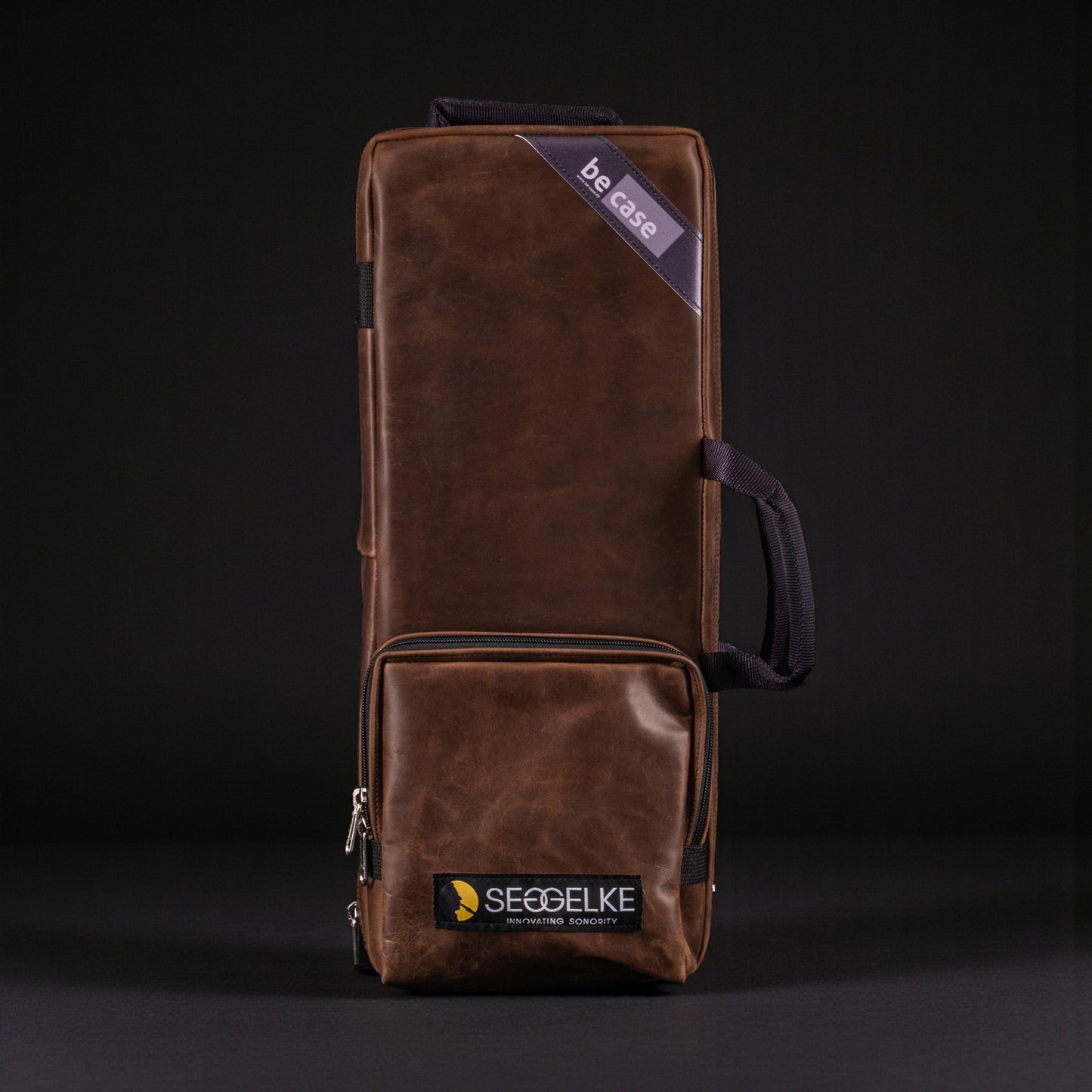
Handmade natural leather case
FAQ
Best option: come to the shop in Brooklyn. Frankly, a flight to NYC would be cheaper than me sending it to you with our trial fees. Schedule an appointment here! Why would a flight be less expensive? Read on:
To be really frank, this is a really special instrument and it's not something we want to send out a lot. So, we charge more for this trial than we do for other clarinets. If you plan to purchase it, awesomesauce. If you think you're going to return it and are interested in just giving it a blow, it's gonna cost you. (Sorry).
Like all Earspasm instruments, this basset clarinet comes with a 7-day trial, which means you have 7 days from the date of receipt to try the clarinet. If you don't like it, that's fine (my feelings aren't hurt!) — just let me know and I will send you a return label. Box it all up and send it back.
Unlike our soprano clarinets that have a 5% return fee, for this basset clarinet, we keep 6% to cover credit card transaction fees and a round trip back to my technicians to do a reset on the horn. This thing is more complex, hence the extra point on the return fee. So, you'd be looking at about $1,300 to try it, including shipping. I know: that's a lot. Hence my suggestion of trip to NY!
A standard A clarinet goes down to low E. A basset clarinet extends four semitones lower, to written C. Mozart wrote his Clarinet Concerto and Quintet for this extended range—but Stadler's instrument didn't survive, and when the Concerto was finally published in 1801, the editor just moved the impossible notes up an octave. Most performances you've heard are playing the compromise version.
The Backun Lumière (~$13,700) and the Uebel Zenit extension (~$4,800) are both excellent modern basset clarinets with forward projection and contemporary bore designs. They play and sound like 21st-century instruments that happen to go lower. The Seggelke costs more and gives you period acoustic architecture—the Liebesfuß bell, the bent barrels, the tonal conception Mozart was writing for. Neither Backun nor Uebel offers a historical bell option.
I wrote a whole article on this that you should read. But the TL;DR version is: Grenadilla, cocobolo, and mopane do sound different. Grenadilla tends to project more, cocobolo feels warmer behind the horn, and mopane refuses to pick a lane and somehow does both. This Seggelke is mopane—there's a golden quality to the sound, less clinical than grenadilla, more singing.
Yes, it comes with Seggelke's standard warranty — which is to say, he will fix it for the lifetime of the instrument. If you ever have any problems, let me know and I will contact Jochen Seggelke. But be aware: because his instruments are kinda different, we might need to ship it to Germany for any repairs.
Inspect the package before you sign off at delivery! If there are any issues resulting from shipping, we have taken out an insurance policy to cover damage (and loss). But we need you to document this damage or we can't do anything to help. Please read my trial policy for how to handle this issue, should it arise.
In the case of this basset clarinet, yes, you will be responsible for both the shipping-to-you costs, and the return shipping costs. We will provide a label that includes insurance, so you don't have to worry about that!
Yes, but there are no returns for this clarinet if shipped internationally. You can add your shipping address when checking out to see what the shipping costs will be before taking the plunge. Note that VAT and Customs Duties are not included in this cost.
Frankly, this is the way. Click to set up an appointment our appointment calendar!
Verfügbarkeit für Abholungen konnte nicht geladen werden