Seggelke Boxwood Bb Clarinet
Seggelke Boxwood Bb Clarinet
Seggelke. IYKYK. But if you don’t, here’s what’s what.

This is Jochen Seggelke on my right, and we're standing standing in Martin Suter's (Blashaus dude) workshop in Lucerne, Swizerland. If you're wondering, yes — I’m holding one of his basset clarinets with the “Mozart Bell” up to my ear like a tool.
Jochen is a freaking genius. Like, off-the-charts brilliant. He’s an inventor (check out his servo-activated CLEX contrabass clarinet and prepare to be amazed), an instrument historian, a craftsman (every key is soldered by hand, no jigs), and probably also a chess master and Olympic javelin gold medalist.
He started making clarinets in 1995, but only German-system clarinets. My teacher, Charlie Neidich, went to Bamberg to talk him into making French-system clarinets. Voilà: the rest of the world discovered Seggelke. Credit where it’s due: Charlie lit the fuse.
Each instrument is handmade, and Jochen says each one takes about 100 hours to produce (he’s “trying to get it down to 70,” lol). Naturally, that means they’re rare, expensive, and hard to get — which is why I carry them here on Earspasm: so you don’t have to book a flight to Bavaria.
A Modern Classic, Built the Old Way
Jochen’s an inventor, but also a historian. He’s the only maker in the world producing true “period instruments,” so he understands everything about wood, bore, and keywork from the 18th century onward — and still keeps up with 21st-century tuning, ergonomics, and production. His clarinets are this fascinating collision of old and new.
This particular one? A boxwood Bb clarinet I picked up in Europe this fall.
Here’s how Jochen describes boxwood:
Boxwood has been used in instrument making since the clarinet was invented over 300 years ago. It fell out of favor in the early 20th century with the rise of industrial production and imported exotic woods. Our work rebuilding historical clarinets — and the audibly different character of boxwood — inspired us to make modern clarinets from this fantastic material again.
He’s right. These things sound incredible across all dynamics. Soft, they’re a smooth, thin layer of butter. Loud, they’re a locomotive… covered in a thin layer of butter.
I played this clarinet for 30 seconds and knew I had to have it in the shop. (In fact, please don’t buy it — I’d like to hang onto it a while.)
Caring for Boxwood
Boxwood needs more frequent oiling, using a skinny bottle-brush-style tool (I’ll include one). Instead of following a schedule, check the bore regularly — you’ll know when it looks dry.
Use pure raw linseed oil: put a few drops on the brush, then wipe the brush twice with paper towels so there’s almost no oil left. Gently oil the bore, being extremely careful not to touch the pads. Do the barrels at the same time.
Resistance: 5/10, Medium
Resistance-wise the Seggelke Boxwood is pleasantly resistant, but not overly so. It doesn't take a ton of air to make it vibrate, but once you have that column going, it really rounds out nicely. Unlike some clarinets that can get shrill when played loud in the upper register, this one holds its core like an instrument that is much more resistant...but it's not. It's a crazy thing.
When listening for how a clarinet responds to added air pressure and embouchure control, listen to the Weber example (wide dynamic range and color range), then the Berlioz excerpt (wide dynamic range, but narrow color range), and finally the Gershwin excerpt (narrow dynamic range and narrow color range). You will hear how these clarinets respond — for better or worse! — to my input as a clarinet player.
Then compare the Boxwood Seggelke to, I dunno, an Uebel Zenit or Uebel Vision in Mopane, or a Backun Lumière in Cocobolo. All are top-tier, all completely different beasts.
Design Notes
- The thumb F key is rotated slightly from where you’d expect. Odd at first, but actually ergonomic once you play it.
- Rollers between the right-hand pinky F/Ab (C/Eb) keys — a nod to German-system design.
- Tone hole inserts and tenon caps made of polymer for added stability.
Comes with
- 64mm, 65mm and 66mm barrels
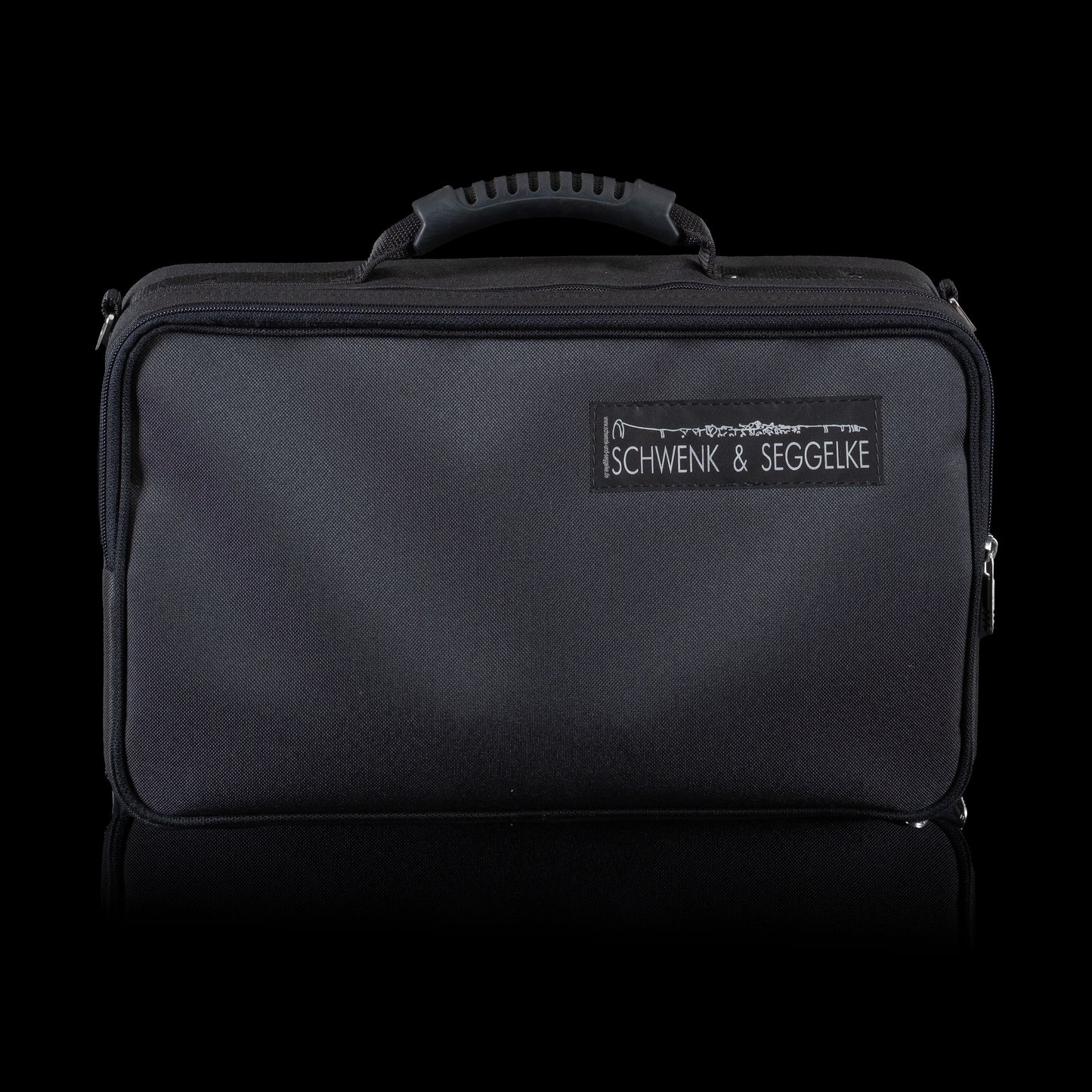
- Custom Seggelke case with memory foam
All earspasm instruments come with a 7-day trial. Please see my trial policy before pulling out that credit card.
FAQ:
Q: What if I'm in New York and want to try it in person?
A: Contact me to set up an appointment, and let's do it!
Q: Does the instrument come with a warranty?
A: Standard 2-year Seggelke warranty. Since he’s running small operation in Europe, warranty work takes a little longer, but it’s worth it.
Q: What happens if it's damaged during shipping?
A: Inspect the package before you sign off at delivery! If there are any issues resulting from shipping, we have taken out an insurance policy to cover damage (and loss). But we need you to document this damage or we can't do anything to help. Again, the trial policy page has information about how to handle this issue, should it arise.
Q: If I decide to return it, do have to pay return shipping costs?
A: Free within the continental U.S. I want you to find the right instrument, and that’s harder to do online.
Q: Do you ship internationally?
A: Yep. Shipping cost shown at checkout. VAT and customs duties not included.
Não foi possível carregar a disponibilidade de retirada.